Blogs
July 08, 2026
Best Recumbent Trike for Seniors: A Dealer's Honest Guide
Best Recumbent Trike for Seniors: A Dealer's Honest Guide
Laid Back Mickey here. The best recumbent trike for seniors is the one fitted to your body, not the one at the top of a list. At Laid Back Cycles we stock more than 40 recumbent trikes across Catrike, TerraTrike, ICE, AZUB, and Greenspeed, and the right pick comes down to your back, knees, balance, and reach. Three wheels keep you upright; a full recumbent seat carries your whole skeleton. This guide shows you how to choose.
What makes a recumbent trike good for seniors?
You've probably got a story in your head about what a trike means. That going to three wheels is admitting something. I get that.
But I tell riders on the phone every week: a trike isn't how you stop riding, it's how you keep riding. The goal was always getting outside and moving. The upright bike is just the tool that stopped fitting your body.
A recumbent trike fixes that in two moves. Three wheels, and a laid-back seat. Everything good about it comes from those two.
Why do three wheels matter as you get older?
On two wheels you have to balance. Every time you stop at a light or a corner, you're catching yourself, putting a foot down, holding the bike up. As we get older, that split-second of balance is exactly where the fear creeps in.
Three wheels take that off the table. You never balance, and you don't fall over at a stop. You sit low, with a low center of gravity, so the trike is stable and planted instead of tippy.
Riders think the tall upright bike is the safe one because it's what they know. In our experience it's the opposite. The higher, narrower bike is the one that puts you on the ground, and the low three-wheeler is the one that keeps you off it.
How does the recumbent seat change everything for an aging body?
This is the part most people miss. They think the fix is a squishier seat. It isn't.
The problem was never the cushion, it was the position.
On an upright bike your weight loads onto a little saddle, your wrists, your neck, and your lower back all at once. Five miles in, even a big padded seat stops feeling good, because everything else is still wrong.
A recumbent seat is a full seat with a backrest. It cradles your back, your hips, and your shoulders at the same time and spreads your weight across all of it, so nothing digs in, your wrists are free, and your neck isn't craned. Riders who come to us with one complaint, usually the back, are surprised to find the trike quiets down four or five aches they'd stopped mentioning.
It's also a genuinely good workout that's easy on the body. Cycling is low-impact and joint-friendly, which is why Harvard Health points people with joint or balance concerns toward tricycles for stability. You get the aerobic work and the leg strength without the pounding.
Are recumbent trikes good for seniors?
Yes. A recumbent trike is one of the best-fitting bikes a senior can ride, because it removes the two things that push older riders off a bike: balancing at stops and the hunched-over posture that loads the back, wrists, and neck. Riders we've fit in their 60s, 70s, and 80s regularly tell us they ride more on a trike than they ever did on their old bike, because it doesn't hurt the next day.
That last part matters more than anything on a spec sheet. People quit riding because they hurt afterward, so they skip the next day, and the day after that, until the bike is hanging in the garage.
When the ride doesn't cost you anything the next morning, you ride again. That day-after-day consistency, not any single ride, is what actually keeps you healthy.
Are recumbent trikes hard to ride or learn?
They're easier than the bike you learned on as a kid. You sit down, and you pedal. There's no balance to learn, because three wheels hold you up for you.
The one thing riders worry about is shifting. If that's you, you have options.
Plenty of trikes run simple gearing, and some can be set up with a single shifter or an internal hub that shifts for you, so there's one lever and nothing to overthink. On a proper fit we'll set the gearing to how you actually ride, not to a race you're not entering.
Are recumbent trikes safe and stable for older riders?
Stability is the whole design. You're low to the ground with a wide, three-wheel stance, so there's very little that tips a trike in normal riding. The lower you sit, the harder you are to knock over.
The one honest tradeoff is visibility. Because you sit low, you want to be seen. That's a solved problem.
We put a tall safety flag on the back and a bright LED tail light, up to 450 lumens, that a driver can pick out from a long way off. Flag up, bright light on, ride defensively, and you're more visible than most upright riders on the trail.
How do you choose the best recumbent trike for a senior?
Here's where the honest answer separates from the listicles. The "best" trike isn't a model. It's a fit.
The same trike that's perfect for your neighbor can be wrong for you if your leg length, your reach, or your back is different. So before we ever talk models, we talk about your body.
How is a trike fitted to your body (X-seam and reach)?
The main measurement on a recumbent is your X-seam, the distance from the back of the seat to the pedals along your leg. It's the recumbent version of inseam and leg length, and it sets where the boom, the tube that carries the pedals, needs to sit so your legs extend right.
From there we set the seat recline angle, the boom length, and the brake lever reach so everything lands where your body wants it. We adapt the trike to you, not the other way around.
A trike that's dialed in disappears underneath you. A trike that isn't will give you back the same aches you got on the trike to escape. That's why we never sell one without fitting it.
Which steering is easier: under-seat or above-seat?
There are two main steering styles on a recumbent trike, and it's worth knowing the difference.
Above-seat steering puts the handlebars up in front of you, a bit like a normal bike. It's intuitive, and most people take to it instantly.
Under-seat steering puts the grips down low by your hips, so your arms rest relaxed at your sides while you ride. Riders with shoulder issues or limited overhead reach often find under-seat the more comfortable of the two, because your hands sit in a natural, dropped position.
There's no universal winner. It comes down to your shoulders and what feels natural when you're actually sitting in the seat, which is exactly what a fitting sorts out.
Do you need electric assist?
Maybe. If you've got hills, or you want more range than your legs give you right now, or your stamina isn't what it was, electric assist is a real answer. Pedal-assist adds power as you pedal, from either a mid-drive motor at the cranks or a hub drive at the wheel, and it flattens the hills without taking the ride away from you.
You don't have to decide today, and you don't have to over-buy. Electric assist for seniors is a big enough topic that it has its own guide, so we won't go deep here. On the fit call we'll tell you honestly whether your riding calls for it or whether you'll be happy without the extra cost.
Which recumbent trike is best for your specific issue?
Most guides stop at "trikes are comfortable" and never get specific. But the riders calling us aren't shopping in the abstract. They're shopping because of one thing: a back, a knee, a balance problem, a body that got heavier.
Here's how we think about each.
Your issue
What to look for in the trike
Feature or assist to add
Bad back
Full recumbent seat with an adjustable recline; supportive lumbar area
Headrest for longer rides; suspension on rougher paths
Bad knees / after a knee replacement
Correct X-seam so knees don't over-bend or over-extend; easy, low gearing
Electric assist to spin easy gears with less load on the joint
Balance problems / stroke recovery
Maximum stability, low seat height, simple controls
Single-shifter or auto-shifting hub; parking brake
Heavier rider
Higher weight capacity, wider stance, sturdy wheels
Reinforced frame options; e-assist for range
Limited stamina
Comfortable seat you'll want to sit in for a while
Pedal assist to extend how far you can go
What's the best recumbent trike for a bad back?
If the back is why you stopped riding, the recumbent seat is doing the heavy lifting. You want a full seat with an adjustable recline so we can set the angle that unloads your lower back, and often a headrest so you can rest your head on longer rides. The more you lean back, the more you'll want that headrest.
What's the best recumbent trike for bad knees or after a knee replacement?
Knees are all about the fit and the gearing. Get the X-seam right so the knee doesn't over-bend at the top of the stroke or lock out at the bottom, and give the rider easy gears to spin instead of grind. A lot of post-knee-replacement riders pair that with electric assist so they can keep the cadence high and the load low, which is easier on the joint.
What's the best recumbent trike for balance problems or stroke recovery?
This is where the trike shines and where we do some of our most rewarding work. We're a VA contractor, and we've fit riders coming back from strokes who were sure they'd never ride again.
They get on a trike, realize they don't have to worry about balance at all, and the whole thing opens back up. For these riders we prioritize maximum stability, a low seat that's easy to get into, and simple controls, sometimes a single shifter so there's less to manage.
What's the best recumbent trike for heavier riders?
Weight capacity and a sturdy build are the priorities here. You want a frame rated for your weight with margin to spare, a wide, stable stance, and strong wheels. We'll match you to a model built for it rather than one that's near its limit, and electric assist often makes sense to keep the range comfortable.
Which recumbent trike brands are best for seniors?
We stock all five of the major brands, so we're not talking you into a house model. Each one is genuinely good, and each has a personality. Here's the honest rundown, with real models we carry.
Brand
Example models we stock
What it's known for
TerraTrike
Rambler, Gran Tourismo
Approachable, easy-riding trikes and a strong value at the entry end; a common first trike
Greenspeed
GT20, Magnum
Comfort-focused, well-sorted rides; the Magnum line suits a range of body sizes
Catrike
Expedition, MAX, Dumont
American-built aluminum trikes; the folding Dumont packs into a hatchback for easy transport
ICE
Adventure
Highly adjustable, touring-ready trikes with folding and suspension options for the long haul
AZUB
Ti-FLY 26"
Deeply customizable European builds; the Ti-FLY's full suspension smooths out rough surfaces
Model years, spec, and sales all move pricing, so we keep it live on the site rather than pinned in a guide. Want to see the full lineup with current pricing? Browse the recumbent trikes we stock.
What is each trike brand known for?
If you're brand-new and price-conscious, a TerraTrike Rambler class is a friendly, capable place to start. If comfort over rough ground is your thing, the suspension on an ICE Adventure or an AZUB Ti-FLY is worth feeling. If you need to fold the trike into a small car, the Catrike Dumont is built for exactly that.
Greenspeed sits comfortably in the middle for a lot of riders who just want a well-mannered, comfortable trike. None of these is a wrong answer. The wrong answer is buying any of them without fitting it to your body first.
How much does a good senior recumbent trike cost?
A quality recumbent trike spans from an approachable entry point up into a premium, custom, and full-suspension range. Most riders land somewhere in the middle, for a comfortable, well-equipped trike they'll ride for years. Because model year, spec, and sales all move the number, we quote live rather than list it here.
What do you get in each price band?
Price band
What you get
Who it suits
Entry
Solid, comfortable trike, straightforward gearing, proven frame
First-time triker, flat-to-rolling terrain, budget-conscious
Mid
Better components, more adjustability, folding or lighter frames, more comfort features
Most riders; the sweet spot for daily riding
Premium / custom
Suspension, top components, internal hubs, deep customization, touring readiness
Long-distance riders, rougher terrain, riders who want it dialed to the last detail
I don't love talking about the higher numbers, because it's real money and I know it. But it's the same conversation I have on the phone: this isn't a bike purchase, it's a health tool you'll use most days for years. The riders who spend the most are usually the ones who already bought once and learned what they wished they'd added.
You don't have to undershoot to be smart, and you don't have to over-buy to be comfortable. You can dig deeper into cost in our complete guide to recumbent trikes.
What is the best recumbent trike for seniors overall?
Here's my honest answer after fitting riders on all five brands for over a decade. There is no single best recumbent trike for seniors.
The best one is the one fitted to your body, your back, your knees, your balance, and your reach. A Catrike, a TerraTrike, an ICE, an AZUB, and a Greenspeed can each be the perfect trike or the wrong one, depending entirely on who's sitting in the seat.
Why is the "best" trike the one fitted to your body, not the top of a list?
That's why I won't rank them one through five and send you off. It would be dishonest, and you'd probably buy the wrong fit. What actually gets you on the right trike is a real conversation about your body and how you want to ride.
That's what the Dream Trike Session is for. It's about an hour with me, by phone or video. I ask you the same questions I'd ask if you walked into the shop: what your back and knees are doing, why you want to ride, where you want to ride.
We build a shortlist of one to three trikes together, for your body and your budget, and I lock in a real quote on each before we hang up. You end the call knowing which trikes actually fit you and what each one costs.
You've earned a bike that fits where you are now. Let's find it together. Book your free Dream Trike Session and we'll build your shortlist.
April 09, 2024
Recumbent Bicycle Buying Guide for 2024
For decades, traditional bicycles have dominated the cycling scene. However, in recent years, a compelling alternative has emerged—the recumbent bicycle. Whether you're an experienced cyclist seeking a fresh perspective or a newcomer eager to explore new biking horizons, recumbent bicycles present an intriguing departure from the norm. But what makes them worth considering? In this article, we'll explore the realm of recumbent bicycles, unveiling their distinctive advantages.
In This Article:
What Is A Recumbent Bicycle? [Dispelling Common Confusion]
Why Recumbent Bicycles Are Gaining Speed on Stationary Recumbent Exercise Bikes
The Advantages of Recumbent Bikes
The Disadvantages of Recumbent Bikes
Top 7 Recumbent Bicycle Brands
What Is A Recumbent Bicycle? [Dispelling Common Confusion]
We all know what a bicycle is right? Great. Let’s start with “recumbent”.
"Recumbent" is an adjective that describes a position of reclining or lying down. In the context of bicycles or exercise equipment, "recumbent" typically refers to a design where the rider is seated in a reclined position with their legs positioned in front of them rather than beneath them as in traditional upright bicycles. Recumbent bicycles and exercise bikes are designed to allow the rider to pedal while in this reclined position, offering a more comfortable riding or exercising experience compared to upright models.
“Recumbent Bike” is a term that can mean different things to different people. To one, it may mean the bike they ride to work each day in comfort. To others, it may be the machine that sits in the corner of their living room. And to others, it’s actually a recumbent tricycle they’re referring to. That gives us three distinct meanings of “recumbent bike”.
1. Stationary Recumbent Exercise Bike
This type of recumbent bike is stationary, meaning it doesn't move from its position. It's primarily designed for indoor use, often found in gyms or home fitness setups.
The user sits in a reclined position with their legs positioned in front of them to pedal.
Stationary recumbent exercise bikes are focused solely on providing cardiovascular exercise and are not suitable for outdoor riding
2. Two-Wheel Recumbent Bicycle
This is a recumbent bicycle that typically has two wheels, similar to a traditional bicycle but with a different seating position.
The rider sits in a reclined position with their legs extended forward to reach the pedals.
Two-wheel recumbent bicycles are typically used by cyclists that converted due to comfort.
They offer a different riding experience compared to upright bicycles, with some riders finding them more comfortable due to the ergonomic seating position.
3. Recumbent Tricycle
A recumbent tricycle, sometimes also referred to as a recumbent bike, features three wheels instead of two.
Like the two-wheel recumbent bicycle, the rider sits in a reclined position, but with the stability provided by the third wheel.
Recumbent tricycles offer stability compared to unstable two-wheel recumbent bicycles, making them suitable for riders who may have concerns about balance or those who prefer a more stable ride.
These tricycles are also primarily designed for outdoor use and can be used for leisure riding, commuting, or touring.
If you did a search on the internet 10 years ago versus today, the results for “recumbent bike” would be much different. With the rising popularity of recumbent tricycles, the meaning of the term is being questioned.
Though stationary recumbent bikes currently sell the most units per year in the US, the recumbent tricycle has already passed the recumbent two-wheeler and is coming for the stationary recumbent. An aging population is creating the demand for a comfortable way to cycle that doesn’t require staring at a blank wall (*ahem* we’re looking at you, stationary recumbent).
Why Recumbent Bikes Are Gaining Speed on Stationary Recumbent Exercise Bikes
So why is the recumbent bike industry growing more than the stationary recumbent market?
The Outdoor Riding Experience: Recumbent bikes allow riders to enjoy the outdoors, experiencing fresh air, scenery, and the freedom of riding on roads or bike paths. This outdoor experience is far more enjoyable and stimulating compared to exercising indoors on a stationary bike.
Fresh Air
Beautiful Nature
Variety of Terrain
Social Interactions
More Fun = More Exercise
The Advantages of Recumbent Bikes
Recumbent bikes offer several advantages over traditional bicycles and stationary bikes, including:
Stability
With three wheels instead of two, recumbent tricycles provide enhanced stability, making them suitable for riders who may have balance issues or those who are uncomfortable riding on two wheels. This stability can instill confidence in riders, especially older adults or individuals with physical limitations. A third wheel enables the recumbent riding position without the high instability of a two-wheel recumbent.
Comfort
Recumbent bikes feature a reclined seating position that distributes the rider's weight over a larger area, reducing pressure on the back, neck, and wrists. The ergonomic design can alleviate discomfort commonly experienced with traditional upright bicycles, making recumbents more comfortable for long rides.
Safety
The stability of recumbent bikes reduces the risk of tipping over, particularly when coming to a stop or navigating tight turns. Motorists generally give recumbent riders a wider birth on the road than traditional bicyclists due to their wider and ‘uncommon’ nature.
Accessibility
Recumbent bikes are accessible to a wide range of individuals, including those with mobility impairments, balance issues, or neurological conditions – and simply easier for the everyday cyclist. The design and stable platform make it easier for riders to mount and dismount the tricycle, regardless of physical ability.
Cargo Capacity
Many recumbent bikes come equipped with storage options, such as baskets or rack, allowing riders to carry groceries, supplies, or personal belongings conveniently. The added cargo capacity makes recumbent bikes practical for errands, commuting, or recreational outings.
Visibility
The reclined seating position of recumbents offers excellent visibility to riders, allowing them to see the road ahead without straining their necks. This enhanced visibility can improve safety by increasing awareness of surrounding traffic and potential hazards.
Low-Impact Exercise
Like traditional bicycles, recumbent bicycles provide a low-impact form of exercise that promotes cardiovascular health, strengthens muscles, and improves joint mobility. The ergonomic design of recumbents reduces stress on the joints, making them suitable for individuals with arthritis or joint pain.
The Disadvantages of Recumbent Bikes
While recumbent bikes offer several advantages, they also have some potential disadvantages to consider:
Wider Turns
Recumbents typically have a larger turning radius compared to traditional bicycles, making them less maneuverable, especially in tight spaces. This can be a drawback when navigating sharp corners or congested areas.
Size and Weight
Recumbent tricycles are generally larger and heavier than traditional bicycles due to the additional wheel and frame structure. This can make them more challenging to transport and store, but there are many transportation and storage solutions available.
Speed
While recumbent bikes can be efficient for cruising and leisurely rides, they may not offer the same level of speed or agility as traditional bicycles, particularly on flat terrain or during sprints. The reclined seating position and aerodynamic profile of recumbents can limit the rider's ability to generate high speeds, which may be a consideration for competitive cyclists or those seeking a faster ride.
Cost
Recumbent bikes can be more expensive than traditional bicycles due to their specialized design, components, and manufacturing processes. The initial investment required to purchase a recumbent may be higher, but the value heavily outweighs the cost.
Adaptation Period
Transitioning from riding a traditional bicycle to a recumbent bike may require an adjustment period for riders to become accustomed to the different handling, seating position, and riding dynamics.
While these disadvantages are worth understanding, for most they do not outweigh the benefits of riding a recumbent bike. Ultimately, the suitability of a recumbent bicycle depends on the rider's preferences, needs, and intended use.
Top 7 Recumbent Bicycle Brands
These are the top brands that sell recumbent bikes based on sales volume and product quality:
Catrike
TerraTrike
ICE
GreenSpeed
SunSeeker
Azub
HP Velotechnik
Note: You could get a stationary bike, which some would consider quite affordable compared to some recumbent bikes. But, in our experience, the stationary bike ends up being a very expensive piece of plastic in the corner of your living room.
While each option has its advantages and disadvantages, the decision ultimately boils down to personal preferences, fitness goals, and intended use. Whether you prioritize comfort, stability, speed, or cargo capacity, there's a recumbent bike option to suit your needs.
Regardless of which type of recumbent bike you choose, one thing is certain: cycling offers numerous health benefits, from improving cardiovascular fitness to strengthening muscles and joints. So whether you're pedaling indoors or cruising the open road, embrace the joy of cycling and embark on a journey towards better health and well-being.
January 17, 2024
Choosing Shoes And Pedals For Your Trike
Choosing Pedals
Cycling Shoes
A good pair of cycling shoes for a recumbent trike is an essential piece of accessory for anyone who is serious about their riding and safety – but the best shoe for you will vary depending upon the type of cycling that you do. For sporty leisure rides during the week or weekend, your journey by trike is your best partner for your fitness and cycling life style.
A good shoe that safely keeps your foot on the pedal so that you don’t get heel suck and is comfortable enough to walk into your local Starbucks is a must have. When riding your trike, you want to stay fit, healthy, and have fun and the best way to do this is with a good pair of cycling shoes to increase your performance and keep your feet safe.
When it comes to selecting the right pair of cycling shoes, there are a plethora of options from a huge selection of brands. Choosing the right model at the best brand can be tricky. The key variables when it comes to cycling shoes are the fastening system, the sole, the cleat style, and of course the fit – we’ve researched in detail on each of these to help choose a good casual shoe that fits the every day trike rider’s lifestyle.
We’ve narrowed it down to two main items, a good comfy shoe and a pedal that securely keeps your feet from falling off pedal and getting sucked under the trike, and is easy to release when you want to get out of the trike.
Now shoe models may change from year to year, but the basic concept does not, so we found that a great shoe for a trike rider is either an urban or trekking shoe. These are usually comfortable and easy to put on. We found it best to match the shoe and pedal brand together so they are designed to fit and clip together perfectly. Of all the brands out there we’ve selected Shimano SPD shoes and pedals as the easiest to clip into and fit.
The easiest pedal is going to be the Shimano SPD with Click’r technology. It’s has a versatile CLICK’R binding on one side and flat pedal on the other. It has a lighter spring which is easier to catch and clip into the binding. There are a few different models, we find most riders prefer the one which allows a regular shoe with better grip on the flat side for as quick ride around the block and a clip in side for longer rides and safety.
The pedals we sell online, but choosing the best cycling shoes can be a difficult process, and if done incorrectly, it can be an expensive endeavor if you get a shoe that is uncomfortable. We recommend trying the shoes out at Laid Back Cycles or your local shop.
Still Deciding If Clip In Shoes Are The Way To Go?
Once you’ve done the obligatory “My feet slipped off the pedal” heel suck, cleats are safer and more powerful and a lot more relaxing way to go. When you’re clipped in you don’t have to expend energy keeping your legs up on the pedals. You also get around 20% more power for climbing with cleats versus none. They also help prevent your foot from going into the front wheel spokes on a narrow trike, which could end badly.
The advantage of a trekking or urban Shimano SPD shoe is that you can walk in them without clunking and the wibbly wobbly feeling of leaning forward of an extended out cleat!
For even more performance you can buy good stiff soled MTB shoes over a urban shoe. A stiff sole is important for efficiency and also protects your foot against hot-spot or localized pressure and numbness. You can also find SPD Sandals which works for regular or wider feet.
For adaptive pedals check out TerraTrike Platform Pedals. Also, remember we are here to help with your recumbent cycling needs.
If you have any questions feel free to give us a call, schedule an appointment to drop by or use the website chat box for a quick response.

September 01, 2023
History of the Recumbent Tricycle
History of the Recumbent Tricycle
The recumbent adult tricycle or “trike” continues to grow in popularity. Recumbent trikes are, to many people, the ultimate ride offering comfort, stability, and staying power. So, how did the modern trike reach its current state and popularity? Let’s look at the history of the recumbent tricycle and the many changes this little machine has experienced since its conception way back in the late 1800s.
It Starts with the Safety Bike
We actually have to look at the history of the bike first. It was in the late 1890s that we see the first geared recumbents appear after the invention of the popular “safety bike” by J.K. Starley and Sutton in 1884. The safety bike was the closest to the bikes we ride today, with two wheels of the same size, a center saddle and peddles with a chain. It brought riders closer to the ground, making it easier to mount the bike, unlike the cumbersome and frankly perilous “velocipede” or “penny farthing” bikes of earlier days. The safety bike is the template still used today, offering better control, sturdier frames, and an improved bike riding experience.
Which Leads to the “Normal” Bike
Now, back to recumbents. Charles Challand, an Italian professor living in Geneva, designed what he dubbed the “Normal Bicycle,” the first geared recumbent bike. This precursor to today’s recumbent got its name because, in the eyes of the professor, riding in a reclined position was more natural than awkwardly hunching over the bars of a safety bike. Now, we can go on and on about the many variants of the normal bike but let’s long-story-short-it instead:
1896: Irving Wales of Rhode Island creates a recumbent with hand drive that works like a rowing machine to propel the bike forward, relying on the arms as opposed to the legs.
1901: Harold Jarvis of Buffalo creates a longer wheelbase recumbent with a smaller front wheel and standard rear wheel, steered with a chain-and-sprocket link known as the sofa bike.
1905: P. W. Bartlett of Richmond, England, creates a short wheelbase with the front wheel much smaller at just 16 inches but with the addition of a comfy chair.
1914: A similar design to the sofa bike, an Italian inventor by the name of Guglielmo introduces a steering wheel instead of handlebars. At the same time, a long-wheelbase recumbent bicycle appears in France with possible ties to car company Peugeot, with a much larger rear wheel of 26 inches.
1921: Australian Paul Jaray working for the Zeppelin company, develops a treadle-driven recumbent dubbed the J-Rad, which became widely popular for middle-class families in the Netherlands.
The 1930s Recumbent Boom
We eventually end up in the mid-1930s when interest in recumbents hit a boom in Europe. Italian engineer Ernesto Pettazzoni developed the Velocino, an ultra-short-wheelbase semi-recumbent machine with a tiny 10-inch front wheel and standard rear wheel. Apparently, Mussolini commissioned the Velocino for easy urban transportation, but World War II put an end to that. We see many iterations of the recumbent through the 1930s, including:
1934: The Kington, designed by F. H. Grubb Ltd. of Brixton features a long-wheelbase with under-seat steering and 20-inch wheels with a welded “stretched” diamond frame and the more recognizable low seat. This leads to the Velocycle with a single main tube replacing the diamond frame, which is closer to the recumbents we see today.
1935: The Moller Auto-Cycle is introduced by Holger Møller of Copenhagen and manufactured by Triumph in England with an indirect steering system and steering wheel. The same year the French Ravat-Wonder factory produces the Ravat Horizontal designed by Henri Martin, which led to the sports version with a 28-inch rear wheel with Reynolds lightweight tubing.
All told, the most popular was Charles Mochet’s Vélo-Vélocars which is too long a story to share here. We’ll fast forward to 1932 when the Vélo-Vélocar receives the Grand Prix Lepine for indirect steering for recumbent cycles.
The following summer a racing version of the recumbent broke records for 5-kilometer, 10-kilometer, 20-kilometer, 30-kilometer, 40-kilometer, and 50-kilometer showing the world recumbents were much faster than standard bikes. The many race-focused refinements that came after made this recumbent the most influential of 1930s designs. Henri Martin, a worker of Mochet’s, went on to invent the iconic Ravat Horizontal in 1934.
Picking Up Production
While a few things went on in the 1940s, it isn’t until 1964 that the design of the Velocino gets a second chance thanks to Dutch manufacturer Union. They create the Strano designed by Bernard Overing of Deventer, and the next year, Emil Friedman of Germany shows off his take on the same idea with his “Donkey cycle.” In 1968, Captain Dan Henry builds a long-wheelbase recumbent with sprung 27-inch front wheels.
However, smaller front wheels are preferred because they have higher rolling resistance, weigh less, and have less air resistance for better steering. In 1967, David Gordon Wilson holds a cycle-design competition with first prize going to the recumbent Bicar designed by W. G. Lydiard. In 1972, H. Frederick Willkie II of Berkeley, California, designs a short-wheelbase recumbent called Green Planet Special 1, inspired by Wilson and unknowingly very similar to the Ravat Horizontal. His improvements to his design include the following:
Lower cranks
Moving the small front wheel back to clear the rider’s heels
Under-seat steering
Improved seat, wheelbase, and geometry
The Finish Line
There are endless versions of recumbents in the 70s and 80s, from the Avatar 2000 to the Bluebell and the Easy Racer to the Vector. But these recumbents were all about racing and speed. It took a lot of technical advancements to get to where we are today with recumbent trikes sold in the mainstream. However, it was worth the wait. Their low-to-the-ground position makes it almost (almost) impossible to tip over, the absence of “handlebars” takes the pressure off the wrists, arms and neck, and the wide seat avoids the infamous saddle soreness or crotch pain of the traditional bike seat. The reclined position also reduces stress on the entire body, and knee pain is greatly reduced or even eliminated after long rides.
If you are interested in taking a modern recumbent trike out for a spin, pop into Laid Back Cycles.
July 14, 2023
Used Recumbent Trikes: Comprehensive Buying Guide
A Comprehensive Guide to Buying Used Trikes: Avoiding Costly Pitfalls
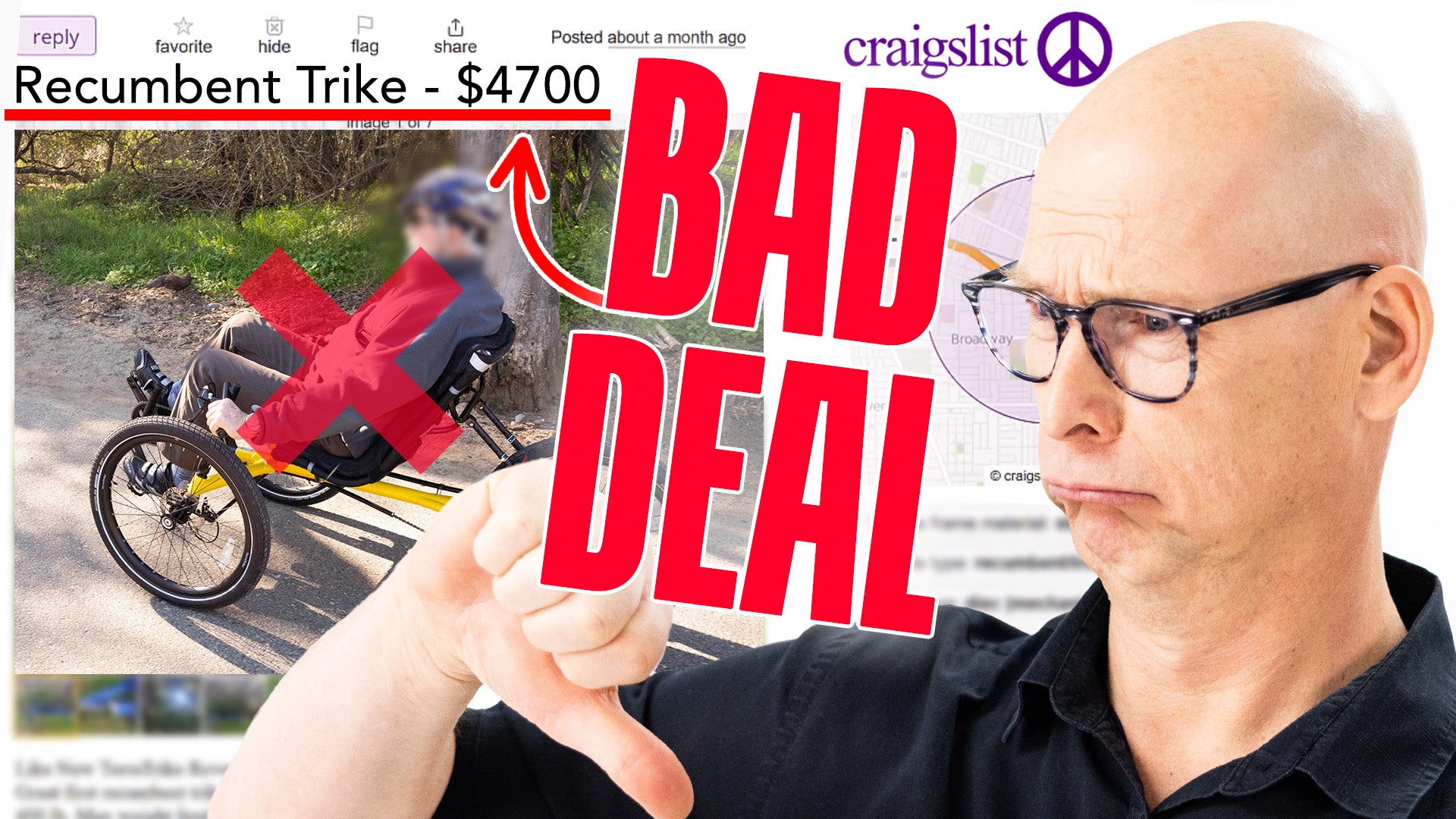
If you're in the market for a used trike, it's important to navigate the process with caution. While there are numerous options available on platforms like Craigslist and eBay, purchasing a pre-owned trike requires careful inspection and consideration. This guide aims to equip you with essential knowledge to avoid potential setbacks and ensure you make a wise investment. We'll address common issues, explore pricing factors, and provide valuable tips to help you make an informed decision.
1. Assessing the Condition
Before finalizing a used trike purchase, it's crucial to thoroughly inspect the vehicle. While you can opt for professional assistance at a local shop, conducting a preliminary evaluation is highly recommended. Here are key areas to focus on:
a) Seat and Frame: Check for any visible damage or signs of wear, such as loose parts or stress marks on the frame. Ensure the seat is secure and in good condition, as replacement costs can be substantial.
b) Gearing and Pedals: Examine the gears and pedals to ensure they function smoothly and do not exhibit excessive wear or looseness.
c) Chain and Hub Mounts: Check the chain for stretching or rust, as well as the hub mounts for stability. Trike chains are longer and costlier to replace, so it's essential to assess their condition carefully.
d) Brakes: Verify the condition of the brakes and determine if they have the desired locking feature for added safety. Older models may lack this functionality.
e) Tires: Inspect the tires for signs of wear, including cracks or dryness. Keep in mind that unused tires can also deteriorate over time, so be prepared for potential replacements.
2. Age and Availability of Parts
The age of a used trike significantly affects its value and maintenance. Older models may be more challenging to find parts for, increasing repair costs and potential frustrations. Consider the following factors:
a) Trike Age: Trikes that are three years old or less are generally more reliable, as they benefit from modern design and technology. As the trike's age increases, the availability of parts and the risk of underlying issues tend to rise as well.
b) Manufacturer Support: Being the second owner of a trike often voids any lifetime or extended warranties that the original owner enjoyed. Understanding the manufacturer's warranty policy and assessing the support available for used trikes is crucial before making a purchase.
3. Pricing and Value Assessment
Determining whether a used trike is priced fairly requires careful evaluation. Here are some guidelines to consider when assessing the value:
a) Trike Age and Condition: Factor in the age, overall condition, and functionality of the trike. Consider the cost of potential repairs or necessary replacements to arrive at an accurate estimate.
b) Resale Value: Keep in mind that used trikes typically depreciate in value. While resale value may not be your primary concern, it's essential to avoid overpaying for a trike that may not hold its value well over time.
c) Consider New Options: Compare the price of the used trike with similar new models. Sometimes, investing a bit more for a new trike can provide greater peace of mind, warranty coverage, and access to updated features and technologies.
4. Where to Look
When searching for used trikes, several platforms can help you find suitable options:
a) Local Marketplaces: Websites like Craigslist and Facebook Marketplace often have local listings, enabling you to inspect the trike in person before finalizing a purchase. This allows you to assess its condition and negotiate with the seller directly.
b) Online Auctions: Platforms like eBay offer a wider range of options, but it's important to exercise caution. Ensure the seller provides accurate information, and consider any additional costs, such as shipping or potential return challenges.
c) Local Dealers: Visiting a reputable local trike dealer offers numerous advantages. They can provide expert advice, assess the condition of used trikes, and may even offer warranties or guarantees. Supporting local businesses also helps build community connections.
Conclusion
When buying a used trike, it's crucial to perform a thorough evaluation, consider the trike's age, assess the availability of parts, and carefully analyze pricing. While cost-saving is a factor, prioritize finding a trike that suits your needs, offers long-term reliability, and brings you joy. Whether you choose to purchase from an online platform or a local dealer, taking the time to research, inspect, and make an informed decision will ensure a satisfying and rewarding trike ownership experience.
Watch the Video:
VIDEO TRANSCRIPT:
0:02 - 0:04: Hey there, in this video, I want to give you some advice on how to avoid getting a bad deal when purchasing a used trike. But first, let's address the missing part on this trike's seat. Stay tuned, because I'll be checking out trikes online later to determine if they're good or bad deals.0:08 - 0:30: There are many used trikes available on platforms like Craigslist and eBay, or you might find one in your neighborhood. However, before buying a used trike, it's crucial to inspect it thoroughly or have it checked by a professional to avoid potential issues and unexpected expenses. As for the missing seat cover on this trike, it was obtained used, and the previous owner gave it away for free due to a stuck crank and a broken seat. If you're the first owner, you usually have the advantage of a warranty on the frame, but if you're the second owner, that warranty may not apply.0:32 - 1:45: When buying a used trike, it's important to consider the age of the trike. Older trikes may be harder to find parts for and could have more problems, even if they haven't been used much. Regular maintenance is crucial, as neglecting it can lead to various issues. For example, certain models require the replacement of specific parts to prevent frame wear. It's generally safer to buy a trike that is newer, as it's less likely to have significant problems compared to one that is five or ten years old. Be aware that older models may have outdated technology or parts that are no longer available.1:46 - 5:00: When assessing a used trike, pay attention to various factors. Check if the gears, pedals, chain, and hub mounts are in good condition. Examine the brakes and see if they have a locking mechanism. Inspect the seat and the frame for stress marks or cracks. Consider the condition of the tires, as even unused tires can degrade over time. Keep in mind that you might need to invest additional money in tires or repairs, so be cautious. Sometimes, the cost of fixing a used trike can be comparable to buying a new one.5:00 - 6:58: To determine if the price of a used trike is reasonable, consider its age and condition. Trikes older than three years may be challenging to evaluate accurately. If the trike is over ten years old, the value decreases significantly. Consulting a local dealer or getting the trike assessed by a professional can help determine if it's a good deal. Buying from a local shop provides benefits such as warranty coverage, better product quality, and community support.6:58 - 13:05: To find used trikes, you can search platforms like Craigslist, eBay, or Facebook Marketplace. However, be cautious about inaccurate age information provided by sellers. It's generally safer to buy locally and from a reputable shop. Shopping at a local dealer ensures a professional has inspected the trike and allows you to ask questions about its condition, warranty, and potential issues. Additionally, local shops often organize group rides and build a supportive community.13:06 - 17:00: Let's now check out a few trikes online to assess their value. Keep in mind that without further inspection, it's challenging to determine if a specific deal is good or bad. A blue Rover trike priced at $875 seems to be in decent condition, but it may be older. Another listing features a TerraTrike Rambler with a motor for $5,000. While it may seem appealing, the older motor and potential battery replacement costs should be considered. A GreenSpeed GT26 priced at $2,500 appears to be a folding trike in good condition, but a shop inspection is necessary for a comprehensive assessment.17:00 - 18:47: Ultimately, buying a trike is about finding something comfortable, enjoyable, and beneficial for your health and lifestyle. Focus on finding a trike that suits your needs and preferences, rather than solely focusing on saving money. Visiting a local shop with a wide selection of models allows you to try different trikes and make an informed decision. If you're interested in learning more about recumbent trikes, feel free to download our free Trike Buying Guide from the description below.Note: The transcript has been edited for clarity and conciseness.
January 12, 2023
Top 10 Fun Ways to Stay Fit Over 50
STAY FIT OVER 50 - TOP 10 FUN WAYS
For active people, it is very difficult to admit that it's becoming harder and harder to stay active with age. However, there are many ways we can all stay fit over 50 and continue to enjoy an active, healthier life. Here we count down the top ten fun ways to stay fit over 50.
10. Yoga
Yoga works on slow movements and deep breathing. As a result, you increase blood flow and warm up muscles. Holding various positions builds strength and maintains a better sense of balance. Benefits include:
Improved flexibility
Stress relief and improved mental health
Assists in reducing inflammation
Increased strength
Improved balance
Improved cardiovascular functioning
Improved sleep
9. Dancing
Whether you were a dancing king or queen in the 70s, enjoy a good polka, or have never danced in your life, dancing is a fun way to stay fit. It's all about choosing the music you love and simply moving to the music. Just dance like nobody's watching. You can dance at home alone, throw a dance party with friends or take to the clubs to enjoy this extremely physical and enjoyable form of exercise. Benefits include:
Improved heart and lung health
Increased muscular strength
Improved endurance
Better motor and aerobic fitness
Toned, strengthened muscles
Weight loss and management
Stronger bones
Improved agility, balance, and coordination
8. Swimming
Swimming is another great way to get some exercise in without too much pressure and wear and tear on your muscles and bones. If you can't swim, it's never too late to learn. You're sure to find swimming classes at your local recreational center. As well you can also choose to take aqua aerobic classes with many benefits, including:
Burns more calories than jogging
Slows down the aging process
Good exercise for people with asthma
Activates the muscles
Gets the blood flowing and heart pumping
7. Running
If you're feeling a lot more enthusiastic about exercise, you can also consider taking up running. Many people discover running later in life and love the challenge of building up their stamina and participating in local marathons. Although running is harder on the body, when done right and using the right shoes, you can really improve your overall health, maintain a healthier weight and look and feel your best. You’ll also:
Reduce cancer risk
Keep your mind sharp
Improve joint health
Reduce stress
Enjoy some peace and solitude
Improve cardio health
6. Hiking
Although you're probably thinking hiking is just walking, there's a little bit more to hiking than meets the eye. When hiking, you're getting into some more challenging paths with more hills and varying levels of exertion. You can explore exciting trails and become more in tune with nature. Benefits of hiking include:
Good for cardiovascular health, reducing the risk of heart disease, high blood pressure and stroke
A boost to bone health as a weight-bearing exercise
5. Tennis
Tennis is probably one of the most fun sports out there. It takes some exertion but at the same time, you don't really notice how much you're working because it's just so much fun. You can also choose other racket-related sports like racquetball or squash. All of these activities are also very social, and you'll probably find it's quite addictive. Tennis offers tons of benefits, including:
Increased aerobic capacities
Lowered resting heart rate and blood pressure
Improved metabolic function
Increased bone density
Reduced body fat
Improved muscle tone
Improved strength and flexibility
Increased reaction times
4. Kayaking and Canoeing
Getting out on the water kayaking or canoeing is a wonderful way to explore nature and also relax and just take in the beauty around you. It's also something that can be done on urban waterways, so if you live near a river, lake or ocean, you can take to the waters and give yourself a relaxing but surprisingly beneficial workout, including:
Improved cardiovascular fitness
Increased muscle strength in the back, arms, shoulders, and chest
Increased torso and leg strength
3. Walking
No doubt, walking is the most accessible activity for people who are still mobile. It just takes 30 minutes a day to get in a good healthy amount of activity, not to mention take in some fresh air and sunshine. Walking is easy because it doesn't require any equipment and can be done anywhere, anytime. Whether you grab a friend, do it solo, walk in your spare time or enjoy a nice brisk walk on your lunch hour, just pop in some earbuds and head out to enjoy these benefits:
Maintain a healthy weight
Lose body fat
Prevent or manage serious conditions like heart disease, high blood pressure, type 2 diabetes, etc.
Improve cardiovascular fitness
Strengthen bones and build muscle
Improve physical endurance
Increase energy levels
2. Cycling
That brings us to cycling. You'll have to invest in a good bike. But once you've got it, the bike will provide a lifetime of enjoyment. Cycling gives you more staying power and allows you to explore local paths and the great outdoors. You can also start cycling to work if you choose and use your bike to run your daily errands, such as grabbing a bottle of wine for dinner or picking up some groceries. Cycling is also a great thing to do with friends and family and allows you to go further than you would when out walking or running. Cycling also:
Improves strength and flexibility
Helps improve coordination and balance
Provides a multipurpose workout
Contributes to mental health
Helps manage conditions like arthritis because it’s low impact
1. Recumbent Trikes
And number one – drum roll, please: The recumbent trike. Trikes offer the best of all worlds when it comes to fun exercise over 50. It has all the same joys that you get from walking and cycling but none of the stress put on your muscles and bones. You get the benefit of aerobics and also increase staying power because of the reclined, comfortable position.
You spread the weight over a larger surface area, so it is a far more comfortable ride than a traditional bike. You also reduce the stress and pressure on your back, shoulders, neck, and wrists. Benefits of the recumbent trike include:
Improved strength and flexibility
A good multipurpose workout
Improved mental health
Low-impact exercise to manage conditions like arthritis
Improve cardiovascular fitness
Strengthen bones and build muscle
Improve physical endurance
Reduced body fat
If you’d like more information on recumbent trikes, stop by Laid Back Cycles. We’re here to help explain the benefits and take you out for a spin.
January 02, 2023
Top Smartphone Apps For Cyclists And Trike Riders
Top Smartphone Apps for Cyclists and Trike Riders
If you’re a tech geek like us, you’re likely looking for the latest apps. Here we look at the top Smartphone apps for cyclists and trike riders.
Strava
If you trike with a group of friends, Strava makes it easy to keep up with each other. The app allows you to record and upload your rides without needing one app as a GPS and another for social sharing. You can also rank your times based on your group’s favorite trails and share the GPS map so your buddies can try out the same experiences. Known as segments, the trails can also be tracked in real-time with speeds, so you know how well you’re performing on more challenging legs of the trail. You can follow fellow trikers, keep up with their rides, and even comment and congratulate friends on their accomplishments.
MapMyRide
This does precisely what it says, allowing you to map and track routes. It also provides monitoring for things like nutrition and weight. If you pay to go up a level, you can also create training plans and enjoy things like live tracking you can share. This app does have ads unless you go with the premium version.
Bikemap
Another route-planning and navigation app, Bikemap’s real-time updates are a great tool to share alerts with fellow Bikemap users like flooded-out trails. This is kind of cool, especially for urban riders who are more likely to encounter daily issues like traffic jams, closed roads, construction, etc. You can access an archive of user-generated routes shared by seven million users, so you're bound to find some in your neck of the woods. The free app can be upgraded to premium to access 3D views of your planned routes which are also kind of cool.
Google Maps
While this might seem like a big yawn, the combination of Google Search and maps makes it a great tool. If you want to find a place for coffee or a smoothie when visiting uncharted territory, this is the quickest and easiest tool to use. It can also show you the most bike-friendly routes to get there from your current location.
Komoot
We can’t deny Google Maps reigns supreme, but Komoot is helpful too. It uses the OpenStreetMap database to help you plan your rides, whether you’re traveling by road, commuting, or hitting offroad trails. Komoot is all about the most efficient route, not just based on your location but also your fitness level and the condition of the route. In fact, it ranks routes based on difficulty and fitness levels and tells you the types of road surfaces you’ll encounter. If you choose a route. it will also provide speeds, travel distances and how much further you have to go. Local recommendations are provided by Komoot ambassadors.
Ride with GPS
This is a very user-friendly interface designed to record trips with a tap. If you tend to travel off the grid, the app also works offline. You’ll also benefit from elevation profiles so you can predict major hills. Rides are shared in real-time. If you’re interested in comments, the app will read them aloud as you ride. Since it’s in real-time, it’s great motivation to keep going on difficult rides. The free app is good enough, but you can opt for the basic subscription if you’re interested in live logging or publishing ride reports.
Wahoo Fitness
Moving on to fitness apps, Wahoo is all about integration and data. It is compatible with things like Bluetooth sensors, heart-rate monitors, speed sensors, etc. and sharable with apps like Strava, MapMyFitness, TrainingPeaks, MyFitnessPal. It also provides eight pages of data with categories that include speed, power, and heart rate. Of course, it also includes a GPS map, but just be aware it will drain your battery juice fast.
TrainingPeaks
If your ride is all about fitness and personal bests, TrainingPeaks offers comprehensive training plans backed by metrics. It’s also the app of choice for cycling coaches. If you are a high-performance athlete who loves to eat up data and track your performance, you’ll love this app. You’ll be right on top of your fitness and fatigue levels. However, this app is all about you, so if you want a social aspect to the app, you’ll need to look elsewhere.
Cyclemeter
Cyclemeter is along the lines of Wahoo Fitness but is more customizable. It also provides post-ride analysis with data stored on your smartphone. It is integrated with Google Maps, and as you ride, you can use your iPhone earphone remote button to start and stop rides. It works with other apps like Strava, Facebook, Twitter (if it’s still around!), etc., so you can import and export routes.
Elite HRV
If you want to keep challenging yourself without killing yourself, this app tells you when you have reached the level to ramp it up. It tracks your heart rate variability (HRV) and provides data with markers so you understand your recovery times. You can then determine when you are ready to manage a more challenging training load. It runs with a Bluetooth heart rate monitor and offers free unlimited data storage. You can tag notes so you have more details about your experience, such as stress levels or mood, keeping your performance in context. The longer you use it, the better the insights.
Wahoo SYSTM
If you use a trainer for your trike, Wahoo SYSTM is an indoor training app providing simulations of real-world climbs. It’s not a virtual world per se, but it provides simulations of pro-race finales or ride along real-world roads through videos. You can also pick and choose workouts with some outdoor options.
Zwift
The real deal for indoor riding, Zwift works with an internet connection and a collection of virtual roads you can ride or race with Zwift users. It is also an efficient training tool with workouts and training plans, but the true focus is social interaction.
Rouvy
Augmented reality and route videos offer a very real-life experience. Actual road and elevation data enhance video recordings by taking elevations into consideration, so you feel like you’re actually there.
These apps offer something for any type of rider, whether you love a leisurely ride in unfamiliar towns, want to beat local traffic for your commute, or are seriously training and challenging your fitness levels.
November 30, 2022
Does Size Matter for Trike Wheels?
Does Size Matter for Trike Wheels?
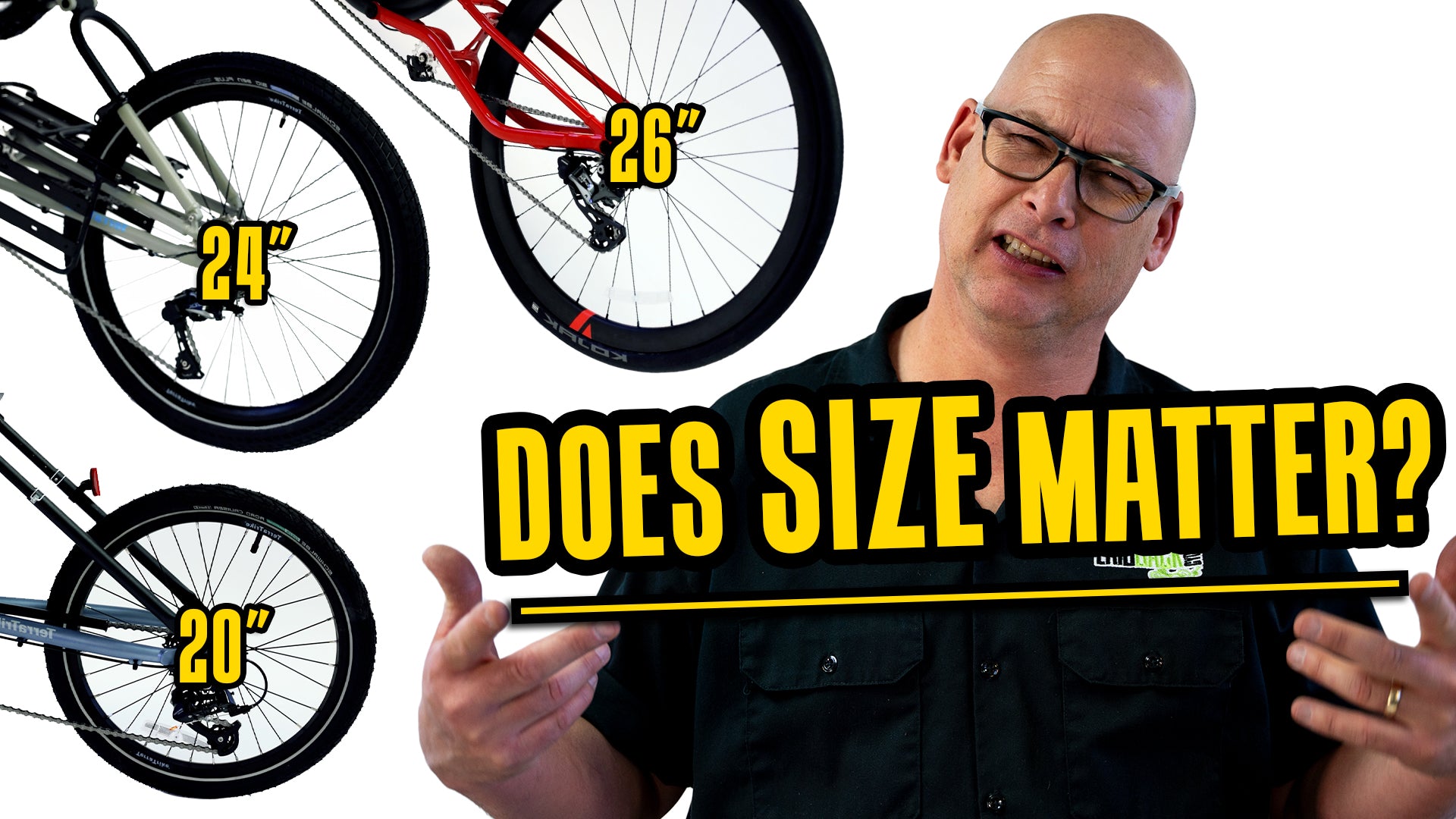
There are a lot of things to consider when buying your first recumbent trike. One thing that might have you stumped is whether the size of the trike wheels matter. What’s better? How does size impact the ride, safety, or even the look of the trike? There are many questions about wheel size you might want to be answered. Here we explain why you might consider one size over another with a technical overview broken down into layman’s terms.
What Do You Want From Your Ride?
We always tell our customers the type of trike features they choose all depend on what they want from their ride. For example, if you want the fastest ride possible, you’re looking at a 26-inch fast wheel. That’s because as soon as you put your foot on the pedal, it does a full rotation, so it pushes farther and faster. If you love the challenge of steep hills or happen to live in a particularly hilly area, a 20-inch wheel, with the small size and right gear ratio, allows you to climb hills with less effort. If you want a little of A and a little of B, the 24-inch wheel is right in the middle.
Is It Just About the Wheels?
That’s a good question. The gearing can help compensate for any wheel size. For example, a trike that has 16-inch wheels, in theory, are too small if you want to go fast. However, it is fast because it has the right gearing to go with it. As a result, it provides the speed and handling we love.
Wheel size does impact how a trike works, but manufacturers compensate for any possible challenges using gearing. It really has more to do with the trike design rather than just the wheel size. The wheel size makes some difference, but it is not everything. And that’s why you’re probably not going to feel much difference just by changing out the wheel.
Gear is not the only thing manufacturers consider. The wheel also affects how the designers make the frames. For example, a race trike has a longer wheelbase that tracks straighter at the expense of handling. As a result, a trike like the GTS has a slightly shorter wheelbase. They still use a larger wheel, which has more to do with options for gearing. With standard gearing and a 20-inch wheel, you’re not going to get your speed higher than 18 to 20 miles an hour. Most of us don’t go that fast, so it’s not a problem. But for the real speedsters out there, it can make a real difference, especially going downhill.
Why is Gear So Important?
Gear is important because wheel size can limit gearing capabilities. Smaller wheels put limitations on gearing. As a result, choosing the wrong gear can mean you don’t have enough chain. For example, a 20-inch wheel is better if you need low gears for things like toting heavier loads or hitting hilly trails. You need more leg power, so lower gears are best. If you need higher gears, the 26-inch wheel is better at holding higher speeds, especially on rougher terrain. You’re looking at a 700c for a racing bike, as they are the fastest around while making high gears easier to access.
How Does Wheel Size Impact the Look?
When it comes down to it, it often is all about looks. Before even worrying about wheel size, check out the trikes on display and decide which one appeals to your sense of aesthetics. Then you can find out the wheel size and other components to see if it’s a good fit. If this isn’t important to you, you can focus on other features to help narrow down your choices.
Other Considerations for Wheel Size
There are a few other considerations when it comes to wheel size. For example, some people like a 20-inch wheel on the front and the back. Why is this such a big deal? You can carry one tube in your emergency repair kit for flats instead of needing two tubes for a 20-24 or 20-26 inch trike. It’s not a big thing, but it does make it more convenient.
You also have to consider the overall size of the trike in relation to your vehicle or your storage space. The 20-inch is going to be the shorter one, so that’ll be easier to fit in the car or in a smaller apartment. If you want a larger wheel, it’s only going to fit in something like an SUV or pickup truck unless you go for a trike that folds. The folding trike is becoming more popular as people opt for smaller living spaces and smaller fuel-efficient vehicles.
What About the Front Wheels?
Another great question. Recumbent trike front wheels normally come in one size -- 20-inch. This is because the smaller size tends to be stronger. When you consider how you ride the trike, the front wheels face higher forces than the wheels at the back. Because of this, if the wheel on the front was larger, it wouldn’t have the resistance required to stand up to things like turns.
Remember, recumbent wheel size is a decision made by engineers who understand how the front wheel stands up to the punishment of even the harshest ride. As a result, there’s a lot of thought put into wheel design and diameter. Every detail of the wheel impacts performance and strength, including spoke angle and size. So, what we’re saying here is, if, for some reason, you have a sudden urge to replace your 20-inch front wheel with a bigger front wheel, resist the urge. It’s all about balance, strength, and engineering when it comes to front wheels.
There you have it. Wheel size does matter, and it all depends on the type of ride you prefer. The larger the wheel, the faster the speed and the smaller the wheel, the less effort it takes to tackle things like hills or heavy loads.
Video Transcript
Laid-Back Mickey here, going over does size matters in wheels? 20-inch wheels, 24-inch wheels, 26-inch wheels, what does it matter and why would you want to get one over the other? In this video we will have a special guest, Master Tech James, go over the technical side of the wheel choosing process. So, let’s check it out and here we go! People ask me all the time, “What’s the difference between a 20-inch wheel, a 24-inch wheel, and a 26-inch wheel” and “Why would I want one over the other?” I have a lot of people go “I want the fastest wheel possible.” So, I say, maybe we’re going into a 26-inch fast wheel that right when you push the pedal it’s doing a full rotation and it’s pushing off further. Some people will say that they need to climb hills a lot better and a 20-inch wheel, with the small size and the gear ratio, allows you to climb the hills a little better. And the 24-inch wheel is right in the middle. It’s that simple, but the gearing can be compensated for any of the wheels. So, one of my favorite trikes was a Green Speed GT and that one had 16-inch wheels. It was fast, but it had the right gearing to go with it. When it comes down to it, it’s about the looks. You figure out if you like the look of a 26-inch or 20-inch. Do you like the fact that a 20-inch has a 20-inch on the front and the back, which that allows you to carry one tube compared to a 20-24 or 20-26 inch which makes you have to carry two tubes when you are out on the road in case you get a flat tire? Which, hey, get thorn resistant tires if you don’t want a flat tire. And the cool thing is that some people ask “which one fits easier in my car?” Well, the 20-inch is going to be the shorter one so that’ll be easier to fit in the car. With the 26-inch you’ll have to either have a small SUV or maybe you get one that folds in order to fit it inside. Now let’s go ahead and talk to Master Tech James and see what the technical side of it is.Hi, I’m James the Master Technician of Laid-Back Cycles. So, the wheel size from a technical aspect does have little consequences on how they work. But in the big picture it doesn’t matter because the manufacturers compensate by gearing and it really has more to do with the trike design rather than just the wheel size. The wheel size makes some difference, but it is not everything. And that’s why the vast majority of us don’t really feel a whole lot of difference just by changing out the wheel. However, the wheel does affect how the designers make the frames. Like this race trike over here, longer wheelbase things track straighter at the expense of handling. Which is why the GTS has a slightly shorter wheelbase. They still use a larger wheel and that has more to do with options of gearing. With a standard gearing and with a 20-inch wheel we find 18 to 20 miles an hour is as fast as you’re going. Most of us don’t go that fast so it’s not a problem. But for the real speedsters it can make a real difference, especially on a downhill. So, it is easy to go into a rabbit hole on wheel sizes, but the truth is most of the manufacturers pick specific wheel sizes for what they are doing with the trikes. The number one reason that people get larger wheels in our experience is it looks good. Thanks James for the technical side of dust size matter and wheels. So, 20-inch wheels will help you go up the hill easier and 26-inch wheels will help you get going faster from the get-go. But you know, what if you don’t have the strength to go up the hill, what if you don’t have the strength to go faster, and you want to keep up with your friends? Check out this next video and I’ll show you how you can go up hills faster, keep up with your friends better, and we will see you on the next video.
November 03, 2022
Direct VS Indirect Steering on Recumbent Trikes | Which Is Better?
Direct vs Indirect Steering
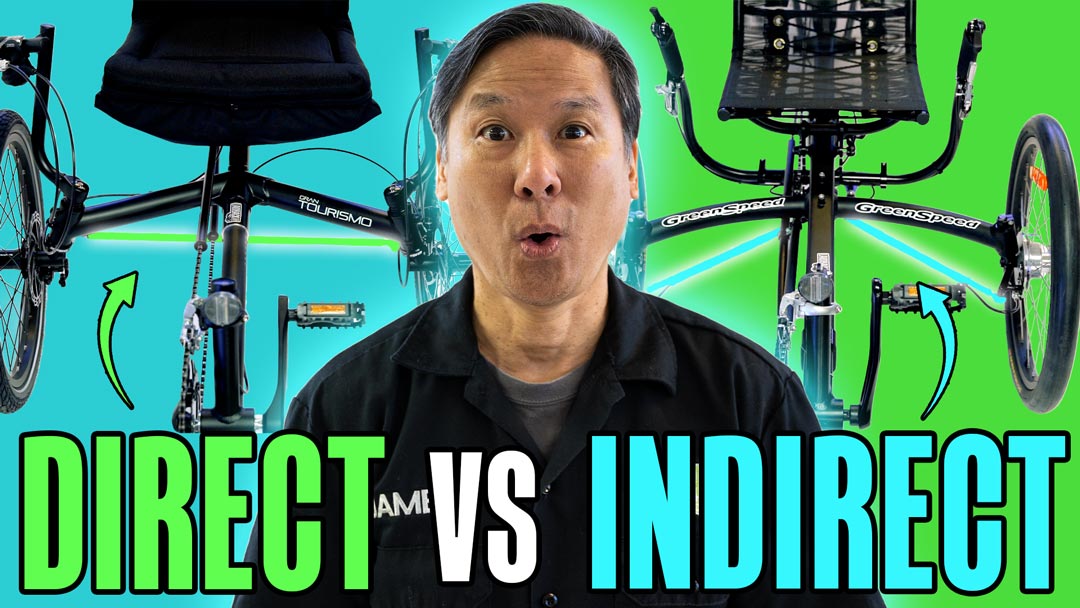
We often have customers ask if they should go with direct or indirect steering for their recumbent trike. There really isn’t an easy answer, as it all depends on personal preference. One is not better than the other, and instead, you want to see which feels right for you. How one rides versus the other depends a lot on the overall design.
There are a lot of design decisions that will affect the feel, including the design of the handlebars, the angle of the head tubes on both systems, and the engineer’s vision when they designed the overall trike. Here we look at direct versus indirect steering to “steer” you in the right direction for your trike purchase.
What is Indirect Steering?
Indirect steering essentially puts the steering on a bearing underneath the seat and operates two tire rods. A plate is attached to the axis, which turns when the handlebars turn. Because of the way it's levered, it takes a lot less energy to move. Although you might find the initial movement is less, as you turn, it turns the wheel more. This can give you a little bit more stability when you're going really fast.
It also gives you a great turn radius which is perfect when you're on a single-lane bike path. However, if you love the rougher paths, you might feel less connected to the road and therefore not as much in control as you’d like. We find Greenspeed has one of the best steering systems out there. You can easily steer with one hand, and you aren’t likely to find it feels jittery at all. When you turn, it has a natural progressive feeling that you’ll appreciate.
Pros of Indirect Steering
When looking at the advantages of indirect steering, it’s all about enjoying less wheel vibration through the handlebars, which many riders find more comfortable. As well, if you tend to ride rougher trails, the indirect steering linkage absorbs some of that bounce you experience on uneven paths. When you combine indirect steering with front suspension, you can tame those rough roads and enjoy a better ride. Indirect steering also takes those turns nice and smooth, so you might feel safer.
Cons of Indirect Steering
Now on the less positive side of things, indirect steering can make you feel disconnected from the road, which can be a little disorienting if you like to go fast. Some people find this feels like they have less control, so if speed’s your thing, you might not like indirect steering as much. Keep in mind many people just need time to get used to how indirect steering feels at high speeds. If you ride a lot, the complex design of indirect steering can become harder to maintain, such as toe-in adjustments that are more complicated.
What is Direct Steering?
Direct steering has handlebars connected directly to the wheels. This has several advantages because, like a sports car, you enjoy the feeling of being directly connected to the road. You actually feel everything, allowing you to correct when you hit little bumps or divots on the path.
As a result, your reaction time is better because you have more input. That said, some riders might find this unpleasant, especially at higher speeds where everything becomes more pronounced. Direct steering is a simpler system run through a single tie rod. For example, the Gran Tourismo’s direct steering is very well-planted. You can feel the road, and you’ll have total control over it. You can move with little effort, even using one hand.
Pros of Direct Steering
The main advantage of direct steering is you enjoy a better road feel. This is especially appreciated when you hit higher speeds. You’ll also find because it has a simpler design, maintenance is a lot easier than indirect steering, including adjusting toe-in.
Cons of Direct Steering
You’ll definitely notice more wheel vibration on rough roads, so you’ll need to keep your hands and arms relaxed to avoid getting jarred when you hit bumps.
Which is Better: Direct or Indirect Steering?
So, that still leaves us with the question, which is better indirect or direct steering? And it still leaves us with the same answer: it depends on what one feels the best for you. To help determine which side of the fence you probably sit on, here’s a look at the ride experience:
Indirect Ride: If you travel fast, on smoother terrain and want to put less effort into steering, you might find indirect steering feels better. Also, if you tend to travel on smooth, single-lane paths, you’ll have less worry about those tight turns. You’ll enjoy less wheel vibration through the handlebars, and the trike will absorb more bounce when on rougher terrain for a smoother ride. As long as you don’t long to feel that true connection to the road and aren’t turned off by the fact the indirect steering trike is higher maintenance, this could be a good place to start.
Direct Ride: If you live for a good road feel, high speeds and less predictable trails, the direct ride might feel better for you. You’ll always have that connection to the road, so feel you have more control. You’ll also enjoy the added benefit of easier maintenance. Just keep in mind this can also translate into a bumpier ride that can feel a little jarring.
When it comes right down to it, you might not really notice much difference between the two types of steering. Where you will find the difference, or more aptly feel the difference is in the ride experience itself. You have to consider the trike as a whole, as opposed to the individual features and components. Triking is all about the experience, so you want to choose a model that makes you feel comfortable on the types of trails you tend to travel.
If you are ready to take some trikes out for a test drive, the team at Laid Back Cycles is ready to help. We can discuss your preferred ride, physical ability and even things like storage so we can recommend the best models to take out for a spin.
Video Transcript
Hi, this is James, Master Trike technician at Laid Back Cycles. Today we are going over direct steering versus indirect steering. Which one is better? Okay, I got you there. One is not really better than the other, they are just different. Indirect steering essentially puts the steering on a bearing underneath the seat and operates two tire rods. Because of the way it's levered it takes a lot less energy to move. Also, the wheels can be engineered because of how they have the tire rods. The initial movement is less but as you turn, it turns the wheel more. This can give you a little bit more stability when you're going really fast; and also gives you a really good turn radius for when you're on a bike path and you have a single lane.
Now direct steering also has this advantage. As its name implies the handlebars are directly connected to the wheels. This has several advantages because like a sports car you are directly connected to the road. You actually feel everything, and you can correct when you have those little bumps or little divots inside of the road. You can react to it a little bit more because there's more input to the driver of the trike. It's a simpler system run through us a single tie rod. How it rides versus the indirect depends a lot on the frame designs and the steering designs. A whole bunch of things will affect the feel. The design of the handlebars, the angle of the head tubes on both systems, and what the engineer was thinking when they designed the overall trike. So, we're going to take these things outside and show you a little bit about the differences.
The direct steering is very well planted. You can feel the road, you have total control over it, and the ability to move it is actually not that hard. You can do it with one hand pretty easily. This system on this Gran Tourismo is perfect. The Greenspeed, especially the GT20, has one of the best steering systems out there. One hand is real easy and it's not jittery in any sense. And when you turn it has a natural progressive feeling. This thing is great.
So, we just got back from our ride over here and as you can see, in actual practice, there's not a whole lot of difference between the two different types of steering. There is a difference in feel though; so you might prefer one or the other. But again the trike is more important than the steering. You should be able to feel comfortable in it before you even get to that point. And then from there if you have two trikes that you like and one happens to be direct steering and one is indirect, pick the one you're most comfortable with. But if you want to know more about the subject you should check out this next video.